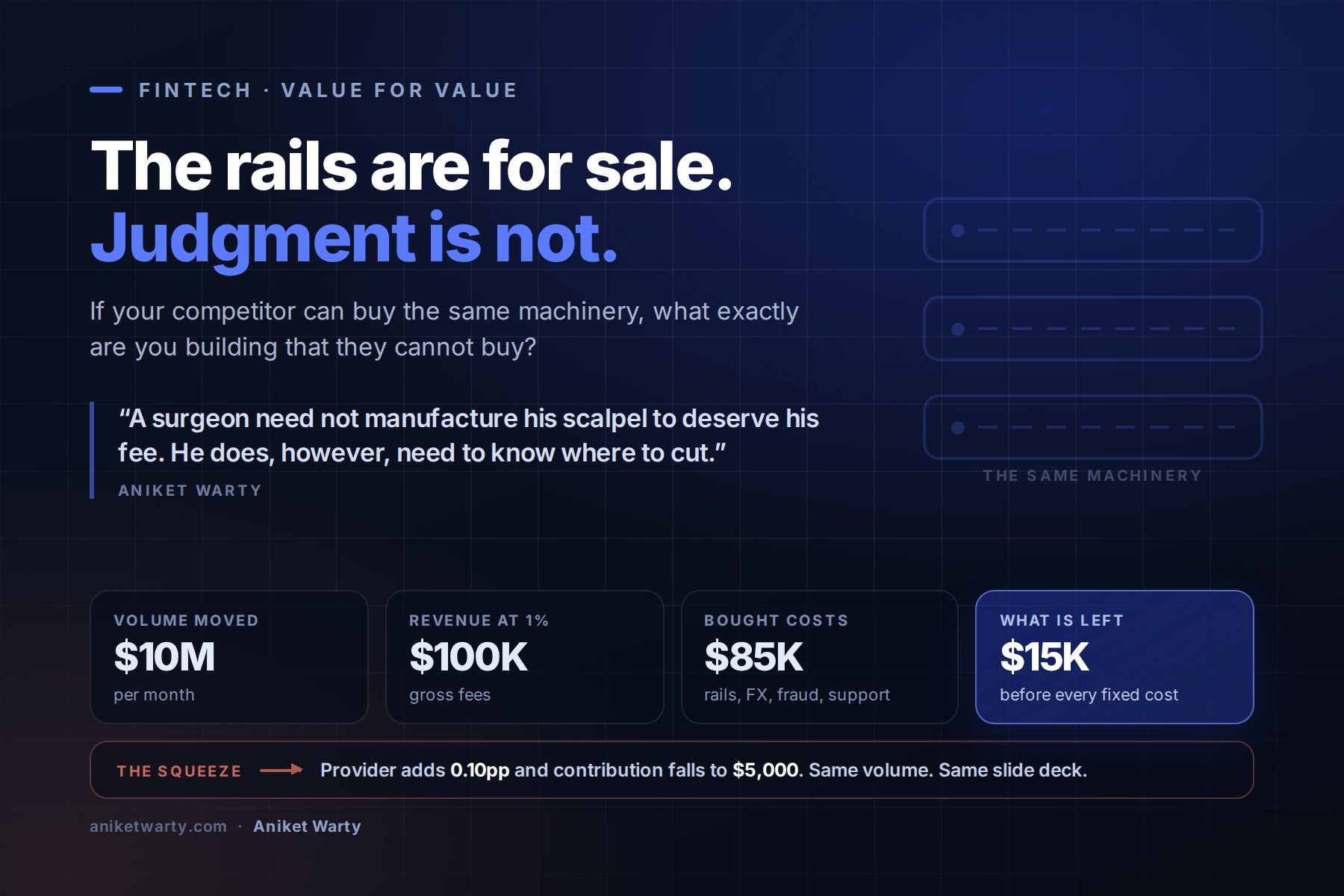
If your competitor can buy the same machinery, what exactly are you building that they cannot buy?
On 3 August 2026, BVNK officially became part of Mastercard. Its announcement described bringing stablecoin infrastructure together with Mastercard’s reach, with broader capabilities to follow. Existing customers were told nothing changed for them that day. Fair enough. Acquisitions take longer to digest than press releases. BVNK’s announcement.
For anyone building a fintech, however, the question deserves immediate attention: if your competitors can buy access to the same machinery, what exactly are you building that they cannot buy?
I am asking that of Zen as seriously as I am asking it of anyone else.
A logo on someone else’s product is a thin business model. It can be a perfectly sensible place to start. It becomes an expensive misunderstanding when the founder mistakes it for the destination.
Stripe had already completed its acquisition of Bridge on 4 February 2025. These are businesses assembling the infrastructure through which other businesses will move money. I see considerable opportunity in that consolidation, provided we are honest about where our own contribution begins. Stripe’s announcement.
Everyone Does Not Have Identical Rails
The title needs one qualification. Everyone does not have identical rails. Geography, permissions, underwriting, capital requirements and commercial terms still determine access. A supported country on a website does not mean your particular customer, entity or transaction will be accepted. Anyone who has confused a coverage map with an executable business plan should revisit the contract.
Nevertheless, access to capable infrastructure is something a growing range of providers sell. Once I can purchase a capability, I should expect a sufficiently competent competitor to purchase it too. My business must survive that fact.
I have no philosophical objection to buying the machinery. Quite the reverse. The division of labour is one of civilisation’s great achievements. A surgeon need not manufacture his scalpel to deserve his fee. He does, however, need to know where to cut.
The entrepreneurial task is to decide which work creates an advantage worth owning and which work another specialist can perform better. Building everything internally can be vanity with a payroll attached. Buying everything without retaining judgment leaves the company equally exposed.
The Merchant’s Actual Problem
Consider a merchant receiving payments from customers abroad. He has suppliers to pay, a payroll approaching and an accountant trying to reconcile the previous week. Give him a wallet, a card and an exchange screen, and you have given him three more things to manage unless they work together around his actual business.
He needs to know how much money is available, what it will cost to convert, when a supplier will receive it, and which transaction belongs against which invoice. If something fails, he needs a person who can explain what happened and get it resolved. Preferably before Friday becomes Monday.
Solving that sequence has value. Providing five disconnected features and calling them an ecosystem does not establish that you have solved it.
That is the standard I want applied to Zen. Across ZenPays, ZenWallet and Zen Card, the commercial purpose must remain visible: help a particular customer receive, manage and use money with less expense, uncertainty and wasted effort. Each product has to justify its place in that experience. I am interested in what the customer can accomplish when the pieces work together.
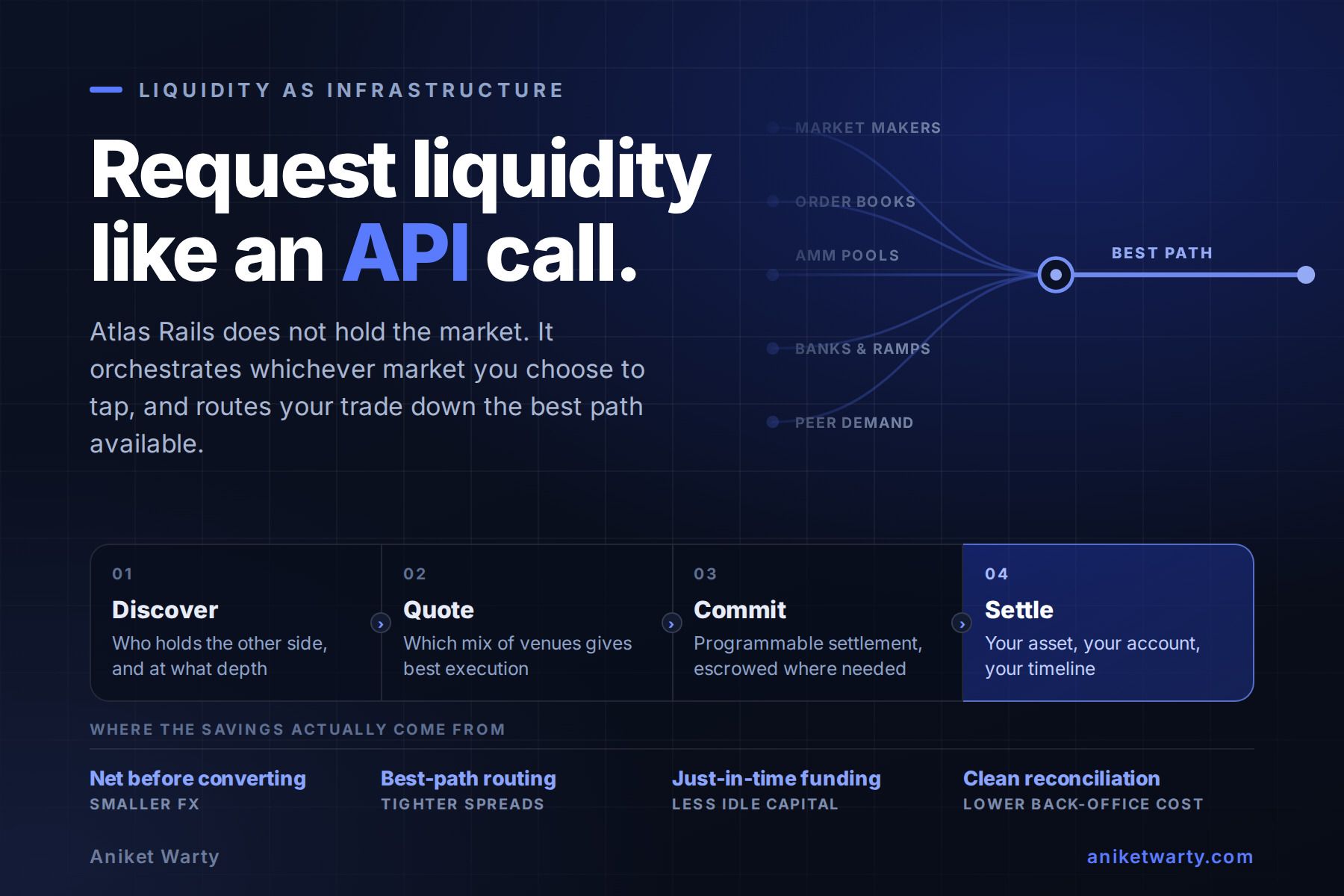
The same discipline governs how I think about Atlas. My intention is to build a routing and settlement layer that can choose appropriate funding, conversion and payment paths around the customer’s intended outcome. Atlas is work ahead of us. I will judge it by the transactions it completes and the problems it removes.
You Do Not Own the Customer
There is an awkward phrase in this industry: owning the customer.
You do not own him. He is an individual with his own purposes, his own money and the right to leave. His data is not abandoned property because he completed your onboarding form. I cannot defend my freedom to build while treating somebody else’s freedom to choose as an inconvenience.
What a business can earn is the relationship. It can become the place he trusts to solve a recurring problem. That means understanding his circumstances, communicating honestly, handling failures competently and remembering enough about his authorised preferences to spare him unnecessary repetition. It also means being clear about which company provides which service and who holds his funds.
The distinction has commercial consequences. If the provider controls the account, the customer communication, the pricing, the records and every meaningful decision, I want to understand precisely what our company contributes and retains. Perhaps it is distribution. Distribution can be extremely valuable. Then let us price it honestly and build a good distribution business.
Pretending to own a financial platform because we chose the colour of its buttons will not improve the economics.
Nor does a long customer list settle the matter. How many customers return without another subsidy? What useful service makes them stay? Can we resolve their problems ourselves, or do we forward emails to a supplier and hope? Those questions tell me more than the number of registrations on a presentation slide.
There is also the work of finding customers economically. A specialist who understands a merchant community, speaks its language and reaches it through trusted channels may build a profitable business on infrastructure available to everyone. I would take that advantage seriously. But customer acquisition has to be paid for, and the relationship has to survive the introductory offer. If the only reason people arrive is a subsidy and the only reason they stay is another subsidy, somebody is financing a queue.
Some Money Against the Argument
Now let us put some money against the argument.
Take a hypothetical payments business processing $10 million a month and collecting an average fee of 1%. Revenue is $100,000. Suppose its infrastructure costs are $60,000, conversion and payout costs another $15,000, and fraud losses and direct support costs $10,000. That leaves $15,000 before marketing, engineering, management and other fixed costs.
The business has moved ten million dollars. It has fifteen thousand dollars left to help pay for being a business. These are invented figures, but the arithmetic is real.
Now the provider increases its charge by 0.10 percentage points on that volume. Another $10,000 disappears. Contribution falls to $5,000, unless the company can change its pricing, costs or route. A founder celebrating payment volume while ignoring this sensitivity is applauding a packed restaurant without checking whether dinner costs more to serve than the customer pays.
I Want Profit, and I Will Not Apologise for It
I want profit. I have no intention of apologising for that.
I reject the suggestion that an entrepreneur must justify his earned prosperity as an accidental byproduct of serving everyone else. My life and purposes have value in their own right. I build because I choose to, and I expect to benefit. The moral condition is honest, voluntary dealing: respect the other person’s rights, deliver what you promised, and accept his right to decline. No apology for succeeding.
Profit earned through voluntary exchange pays for the people, capital and continuing improvement that make a service worth using. It also gives the enterprise room to survive an unpleasant month. A business permanently dependent on fresh funding to subsidise ordinary transactions has a question to answer, however attractive its growth chart looks.
That does not prohibit deliberate investment or early losses. I will spend money to build something valuable. I want a credible explanation of how the investment changes future economics, who benefits, and what evidence will tell us whether the explanation was wrong. Calling every loss strategic is a remarkably convenient accounting policy.
The trade should improve both parties’ position. If we remove meaningful cost or effort for a merchant, we can charge for doing so. The merchant retains part of the benefit; we earn part. That is value for value in practice. Hiding an unnecessary fee in a confusing conversion rate does not become productive achievement because the customer failed to notice.
Provider Dependence, Examined Without Sentiment
Provider dependence requires the same unsentimental examination.
A strong supplier has its own interests, customers and priorities. I respect that. Its duty is not to preserve my preferred margin forever. When it broadens its offering, changes its commercial policy or serves a customer directly, indignation is a poor substitute for a business that can adapt.
I want to know what happens if a corridor closes, a service is interrupted or a contract ends. Can we retrieve the records we are entitled to retain? Can eligible customers move to another arrangement? How long would that take, what approvals would it require, and who would explain the disruption? Those answers belong in the design and negotiation, while everyone is still pleased to be working together.
Signing two providers is insufficient if both ultimately depend on the same bank or processor. Two doors into the same locked room provide limited comfort. Genuine alternatives require understanding the dependencies underneath them, testing the route and accepting that some customer relationships or balances cannot simply be moved at will.
There is a cost to this resilience. Additional integrations need maintenance; additional partners need oversight. I do not want an engineering team collecting providers as a hobby. Start with the failure that could seriously damage the business, then buy or build a proportionate answer. Sometimes that means a second route. Sometimes it means a narrower promise to the customer.
And outsourcing a function cannot relieve management of understanding the responsibilities it retains. A partner may perform checks or execute transfers; we still need clarity about our own obligations and what happens when the arrangement fails. The customer who trusted our product deserves more than a screenshot of somebody else’s status page.
The Knowledge You Cannot Buy
For me, the interesting opportunity lies in the knowledge a business accumulates by serving a specific market well. Which documents cause avoidable onboarding delays? Which payment paths work for this customer’s actual circumstances? Where do reconciliation errors begin? What information would have prevented yesterday’s support call?
Answer those questions repeatedly and the company can improve its product in ways a generic infrastructure supplier may have little reason to prioritise. The knowledge must become better decisions, useful software and reliable operating habits. Otherwise it remains a collection of anecdotes in employees’ heads, vulnerable to the next resignation.
Even here, honesty matters. Data needs to be relevant, accurate and legitimately usable before it can improve a decision. And an integration nobody has tested under realistic operating conditions belongs on a development list. I want evidence that it works before anyone sells its supposed benefits to a customer.
I would rather make one commercially important task work exceptionally well for a defined group of customers, learn what they will pay for, and expand from that foundation. The alternative is to launch broadly and discover, at considerable expense, that everyone liked the announcement more than the product.
Where a Founder Earns His Position
This is where a founder earns his position. He chooses. He commits capital, sets standards, rejects attractive distractions and accepts responsibility for the consequences. Technology gives him more ways to act; it cannot supply the purpose of his enterprise. Borrowed infrastructure makes independent judgment more valuable because so much of the underlying machinery is available to others.
At Zen, I want that judgment expressed in the product itself: clear prices, sensible choices, reliable records, effective support and services people deliberately return to. Those are obligations we have to fulfil. Our ambition gives us the reason to attempt them, and our execution will determine what the business is worth.
The established networks are entitled to earn from what they built. Specialist providers are entitled to charge for their competence. Customers are entitled to compare us with alternatives and keep their money when our offer fails to persuade them. I welcome that test. It is the commercial expression of a principle I take seriously: nobody owes us a living.
Give me capable partners, customers with a real problem and the freedom to build. Then judge the result. If Zen saves those customers time, reduces their costs, earns their continued trust and retains a worthwhile profit, we have created something that deserves to exist.
That is what I intend to build. The logo can go on afterwards.